


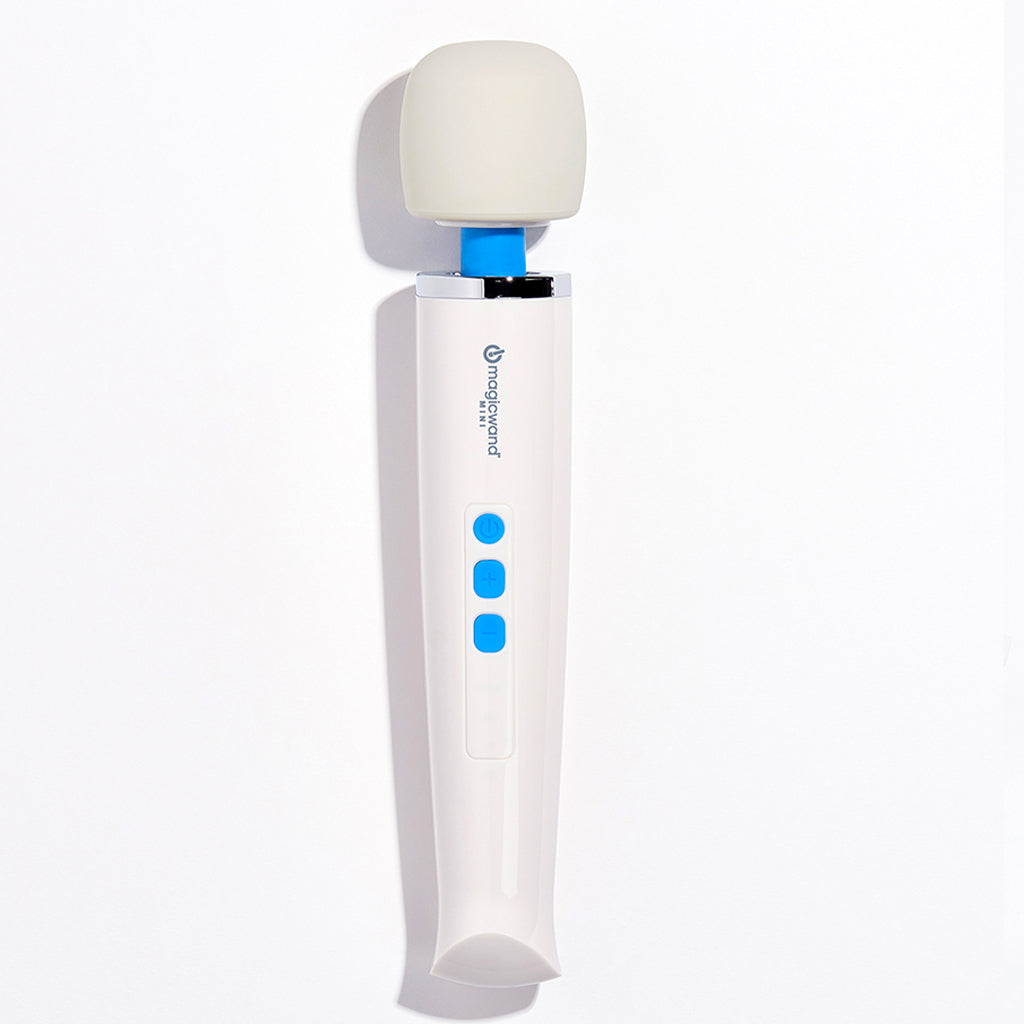


Hitachi first sold the Magic Wand as an electric massager in April 1968, and the United States trademark registered the following year still describes the goods in exactly those words. What happened next was not Hitachi's plan: people used it for something else, and by the 1970s Betty Dodson had put it at the centre of the group workshops that made her name. Hitachi spent decades uncomfortable with the association and eventually asked for its name off the box. That is why the product in front of you is called simply Magic Wand.
Same motor quality at half the weight — 9.7 ounces against the Rechargeable's 1.3 pounds.
Vibratex has handled the distribution since around the turn of the 2000s. The company was founded in 1983 by Harold and Suzi Spielberg and is run today by their daughter, and it is Vibratex rather than Hitachi that imports, distributes and manages the brand now — Hitachi no longer manufactures it either. This is worth saying plainly, because a great many listings still say Hitachi Magic Wand, and you should know what you are actually comparing before you compare prices.
The Mini arrived in March 2022 and is the smallest of the line by a wide margin: 9.6 inches long against 13 for the Rechargeable, 9.7 ounces against 1.3 pounds, and a 1.9 inch head rather than 2.4. Three speeds, roughly 3,500, 5,000 and 6,000 RPM, and no pattern modes at all, where the Rechargeable has four. Up to 2.5 hours of runtime on a charge. Joan Price, reviewing it in June 2022, summed the trade-off up in a line we have not managed to improve on: you get the same quality and most of the power at half the weight.
Material claims stop where Vibratex's do. Vibratex describes the Mini as having a soft silicone head and a flexible neck, and publishes nothing beyond that — no phthalate-free statement, no body-safe wording, no non-porous claim for this specific model. Retailers add those badges routinely. They are not the manufacturer's words, so they are not on this page either, and the warranty Vibratex publishes is one year.


